The Blue Giant’s Rubik’s Cube: How I Built a High-Performance Scraper and Batch-Messaging Engine in 5 Days
Intro
Hello, I'm Lit.
I once stared at a loading spinner so long I started questioning my life choices.
That was the day I decided: if the web is going to be slow, it’s not going to be my fault.
So I built The Blue Giant’s Rubik’s Cube – a scraper + batch-messaging engine that loads faster than my coffee gets cold.
This is how it happened in 5 chaotic, caffeine-fueled days.
It was 2:00 AM in Saigon. The humidity was thick enough to chew, my room lit primarily by the blue glow of 47 Chrome tabs, and my caffeine-to-blood ratio had reached "concerning." I was staring at a Facebook Page’s source code — a masterpiece of architectural spite — realizing I had two choices: spend the next month manually extracting contact info like a digital sharecropper, or spend the next five days building a tool to do it with sub-100ms efficiency that should be a basic human right.
I chose the latter. (I called the early version Project Sanity Leak, because that's what it felt like.) It was a journey through obfuscated DOMs, the isTrusted gatekeeping of a trillion-dollar company, and the realization that sometimes the only way to win is to wait exactly 15 seconds.

A Word of Warning: The Ethics of the "Gray Area" Before we dive into the code, a disclaimer: Facebook absolutely hates this. Their official policy on scraping is roughly equivalent to their policy on people deleting their accounts—they’d rather you didn’t.
The Stack: Velocity Over Buzzwords
When you’re in a 5-day sprint, you don’t pick technology because it’s trending on X; you pick it because it behaves like a grown-up.
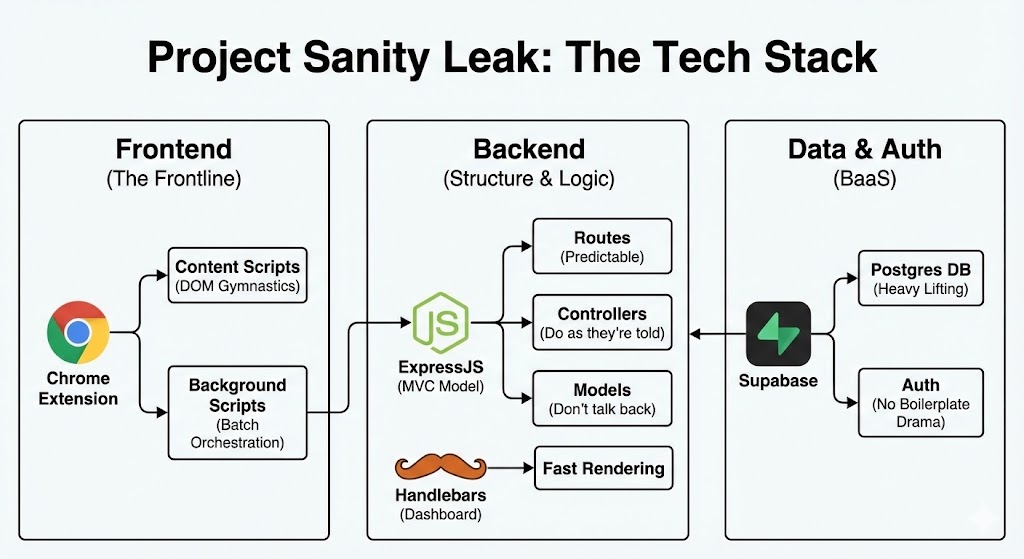
- ExpressJS (MVC Model): I wanted structure without the boilerplate drama. Routes that are predictable, models that don’t talk back, and controllers that do exactly what they’re told.
- Supabase: My Backend-as-a-Service of choice. Why? Because configuring Postgres and Auth manually is a slow death I’m not ready for. Supabase handles the heavy lifting so I can focus on the latency.
- Chrome Extension: This is where the war is fought. Content scripts doing DOM gymnastics to extract data and background scripts managing the batch orchestration.
- Handlebars: For the dashboard. Because a well-placed template is faster than a heavy reactive framework when all you want to do is see your data and get out.
Day 1-2: The DOM Hellscape and the "isTrusted" Wall
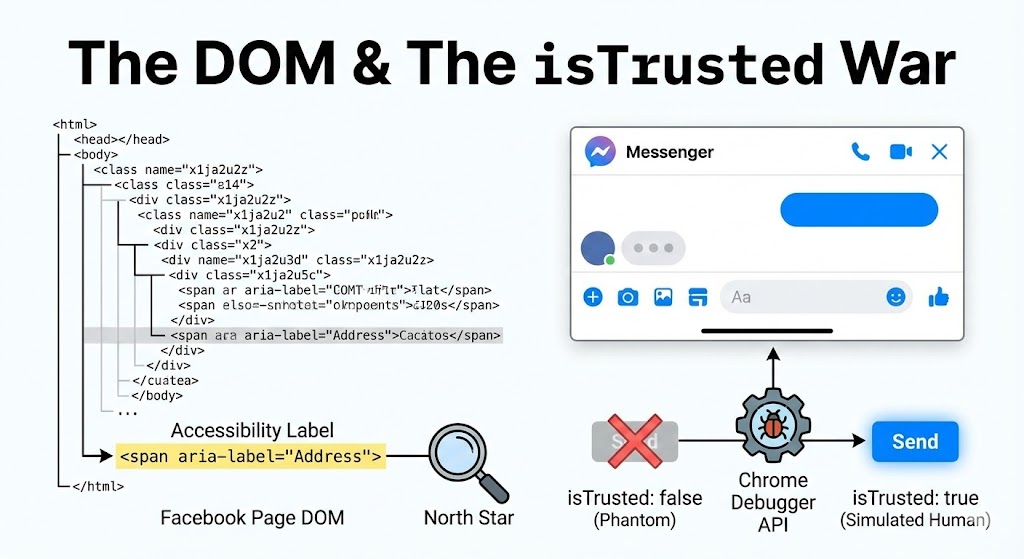
Facebook’s DOM is not designed to be read; it’s designed to discourage the weak-willed. The CSS classes change more often than I change my cold brew order. x1ja2u2z today, x9f619 tomorrow. It’s a game of whack-a-mole where the mole has a billion-dollar R&D budget.
The first "Eureka" moment came when I stopped trying to be "smart" with selectors and started being "human." I realized that while classes are volatile, Accessibility Labels are legally required and functionally stable. If the label says "Address" or "Mobile," that’s my North Star.
But then came the true personal insult: the isTrusted: false flag. Facebook’s chatbox phantoms. You can inject text all you want, but if the event doesn't carry that isTrusted: true badge of honor, the "Send" button stays gray and silent, mocking you. Bypassing this required some creative (and borderline masochistic) use of Chrome Debugger APIs, simulated inputs, and a prayer that the event would feel "trusted" enough. Spoiler: it mostly worked... after many failed prayers.
Day 3-4: The 5-Tab Symphony (and the 15-Second Silence)
Once scraping worked, I needed scale. But scale on Facebook is a fast track to "Account Restricted" glory.
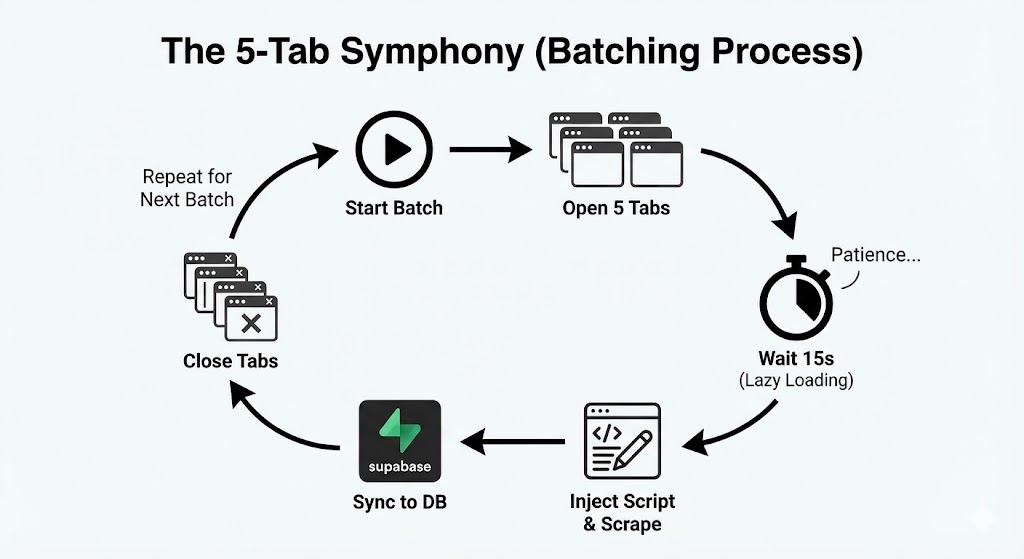
The solution? Batching. I built a loop that opens exactly 5 tabs at a time. No more, no less. But here’s the dry wit of web dev: I am obsessed with sub-100ms latency, yet I had to force the system to wait.
The transcripts of my debug logs tell a story of compromise. I had to implement a 15-second buffer for lazy loading. Why? Because Facebook’s content is like a shy teenager—it only shows up once it's sure you're actually looking. 15 seconds felt like an eternity. It felt like a personal failure. But when those 5 tabs finally load, scrape the emails, phones, and addresses, and then snap shut like a hungry venus flytrap... it’s pure, unadulterated performance art.
Day 5: The Cleanup and the Flex
The final piece of the puzzle was the CSV Loopback. Real-world data is filthy. It’s full of typos and questionable formatting. I implemented a download/upload flow:
-
Crawl the raw data.
-
Download the CSV.
-
Clean it up in Excel (the only place where manual labor is still allowed).
-
Upload it back to trigger the batch messaging.
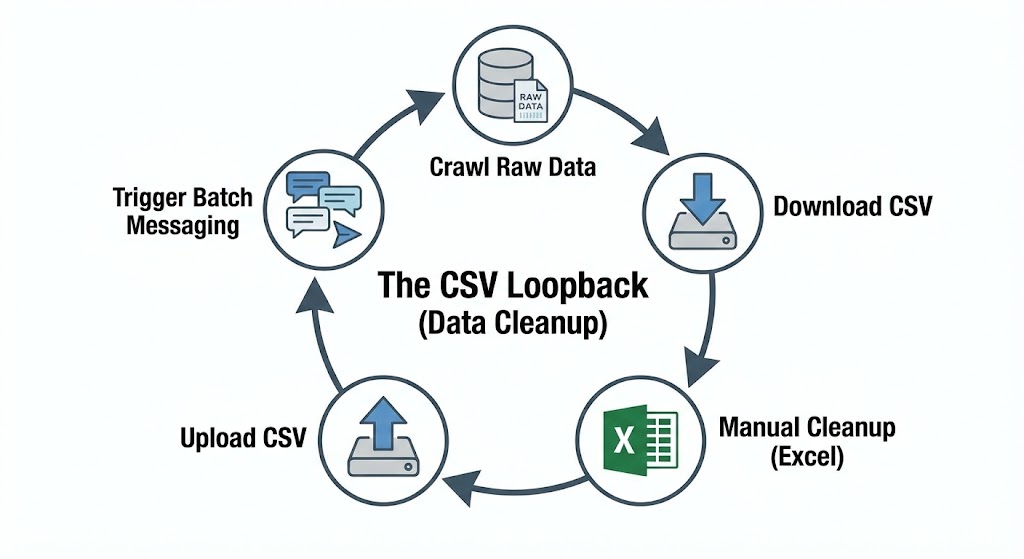
Seeing the "Batch Messaging" module cycle through a cleaned list, opening 5 tabs, injecting the isTrusted messages, and closing them automatically was the "magical" moment. The dashboard now updates in real-time. It moves faster than my coffee gets cold—and in Saigon's heat, that is a high bar to clear.
Lessons from the Abyss
-
Regex is a Double-Edged Sword: I spent three hours chasing a bug because my regex was too "strict." I was essentially gaslighting my own code. In an unstructured world, flexibility is the only logic that survives.
-
Latency is a Basic Human Right: Even if I have to wait 15s for Facebook to load, the processing of that data better be instant.
-
The DOM is a Lie: Trust labels, not classes. The classes are just there to make you feel small.
The Punchline
So, there it is. 5 days from caffeine overdose to a production-ready scraping engine that respects the "batch" and laughs at obfuscation. It’s not "revolutionary" (a word only used by people who don't code), but it is efficient.
Try it, judge my 15-second wait times—or don’t. It’s your latency, your rules. I’m going to go close these tabs now. My RAM is starting to develop a personality, and it's a very stressed one.
Next up: Investigating why Facebook's "isTrusted" check feels like a mid-life crisis for developers. Or maybe I'll just go get another coffee.
Comments
Please login to post a comment.